Garland Mineral Springs

47° 53’ 19” N • 121° 20’ 31” W

  • Home
  • About
    • Location of Garland Mineral Springs
    • The Mineral Waters of Garland
    • Geothermal Waters Beneath Garland
    • North Fork Skykomish River
  • Timeline
  • Journal
  • YouTube
  • Gallery
    • Photo Albums
  • Shop
    • Cart
    • Checkout
    • My account
  • Contact
Home » Garland Journal

Stephen’s Garland Story

September 16, 2015 by Stephen Sharpe

I'm Stephen, son of Curtis who is the middle son of Cameron Sharpe Sr. this is my story of Garland.

Curtis Sharpe's 53 Chevrolet at Garland

My folks Mary Beth and Curtis were living in cabin #1 during the winter/spring of 1962-63. Cabin #1 was the largest of the cabins and had a 2nd floor sleeping loft and apparently it was quite romantic up there during the chill of the winter nights... I was born in Seattle in November of 1963. This was the last time my family lived at Garland.

Fast forward nine years and in 1972 my father resigned his sales career at Best Lock in Chicago Illinois with the dream of rebuilding Garland. I remember he had a place mat drawing of the cabins with the boardwalk. Each cabin restored into village of shops. He was sure Garland could be returned to a working camp.

Sharpe's Service in Goldbar WA - Circa 1973

Dad sold our home in Oak Park and invested the proceeds in a Mobil station and two small houses in Goldbar. His plan was to use the station as an economic base while he figured out a way to rebuild Garland. He put Mom, my sisters Kim and Kris and myself to work, pumping gas and dipping ice-cream. He worked several jobs, driving bus, hauling alfalfa from east of the mountains. We private labeled honey we sold at the market, basically anything to generate a buck.

Visits to Garland during these years were very exciting for nine year-old boy. It was the end of the hippie era and Grampa had permitted a small group of free spirited young adults to live in the cabins. Needless to say there were quite a few natural bathers in the springs during that first summer.

Camping with the 68 Buick Skylark and popup camper at Garland in 1972
Curtis, Marybeth, Kim, Kristin and Stephen Sharpe camping with the 68 Buick Skylark and popup camper at Garland in 1972

At the time Garland had two rows of cabins. You would cross a small bridge over the creek to get to the lower row of cabins. There was a small paddle wheel in the creek that generated power. At the end of the row of cabins was a dilapidated stable, Dad would tell me stories of taking visitors on horseback rides up into the mountains. There were also two rusty visible gas pumps which were already relics in 1972. The foundation of the Lodge was  still visible and the swimming pool was still there but it was filled with the mineral rich seepage from the springs. During this time the soda spring was still accessable and Mom would let us make Tang with the soda water. Wow, all the Orange Soda a kid could drink, it was like Heaven on Earth!

Each of the "big" cabins had a cast iron stove that were used for cooking and heat and several of the cabins were inhabited. I remember there was a boardwalk along the front of the cabins that would allow you to stay out of the mud when it was raining. The cabin residents had small chicken wire and wood cages with pet chipmunks. On one visit, I had my first taste of cast iron skillet grilled rattlesnake. The "mountain man" who shared this delectable treat with me told me he would catch and kill the snakes, clean them for the meat, drive a nail through the head on a piece of wood and throw the skins on the roof of the cabin to dry. I can still remember the sight of a rattlesnake skin on the roof.
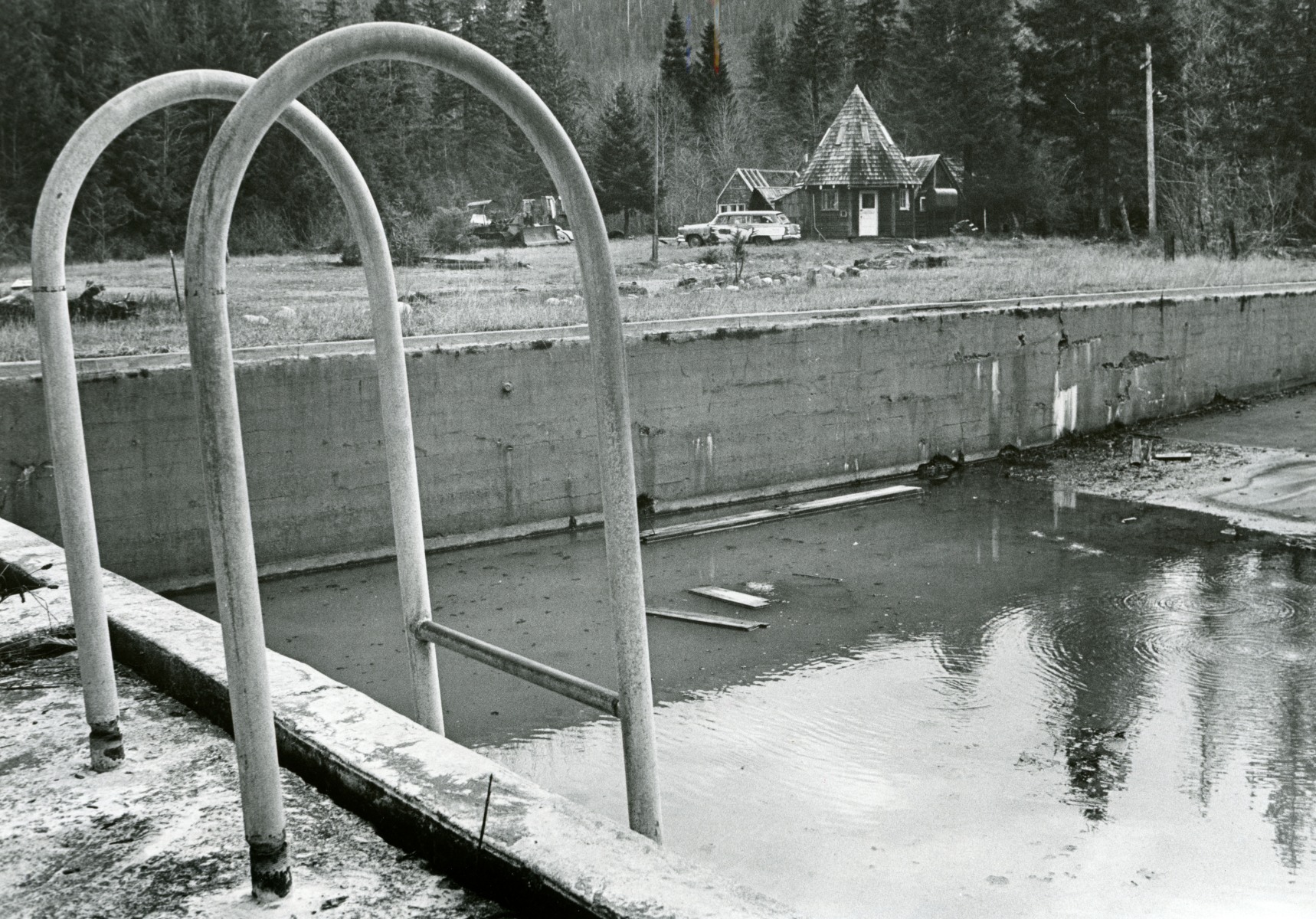
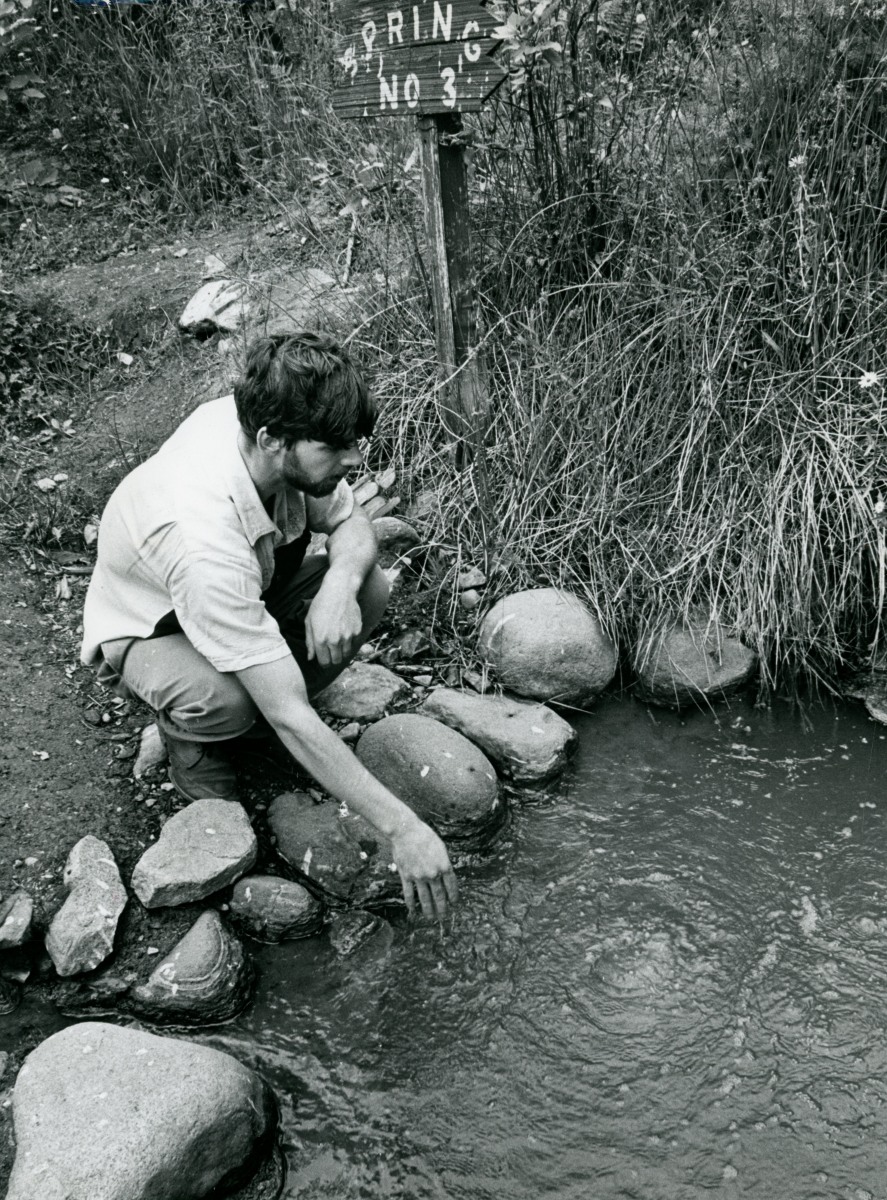
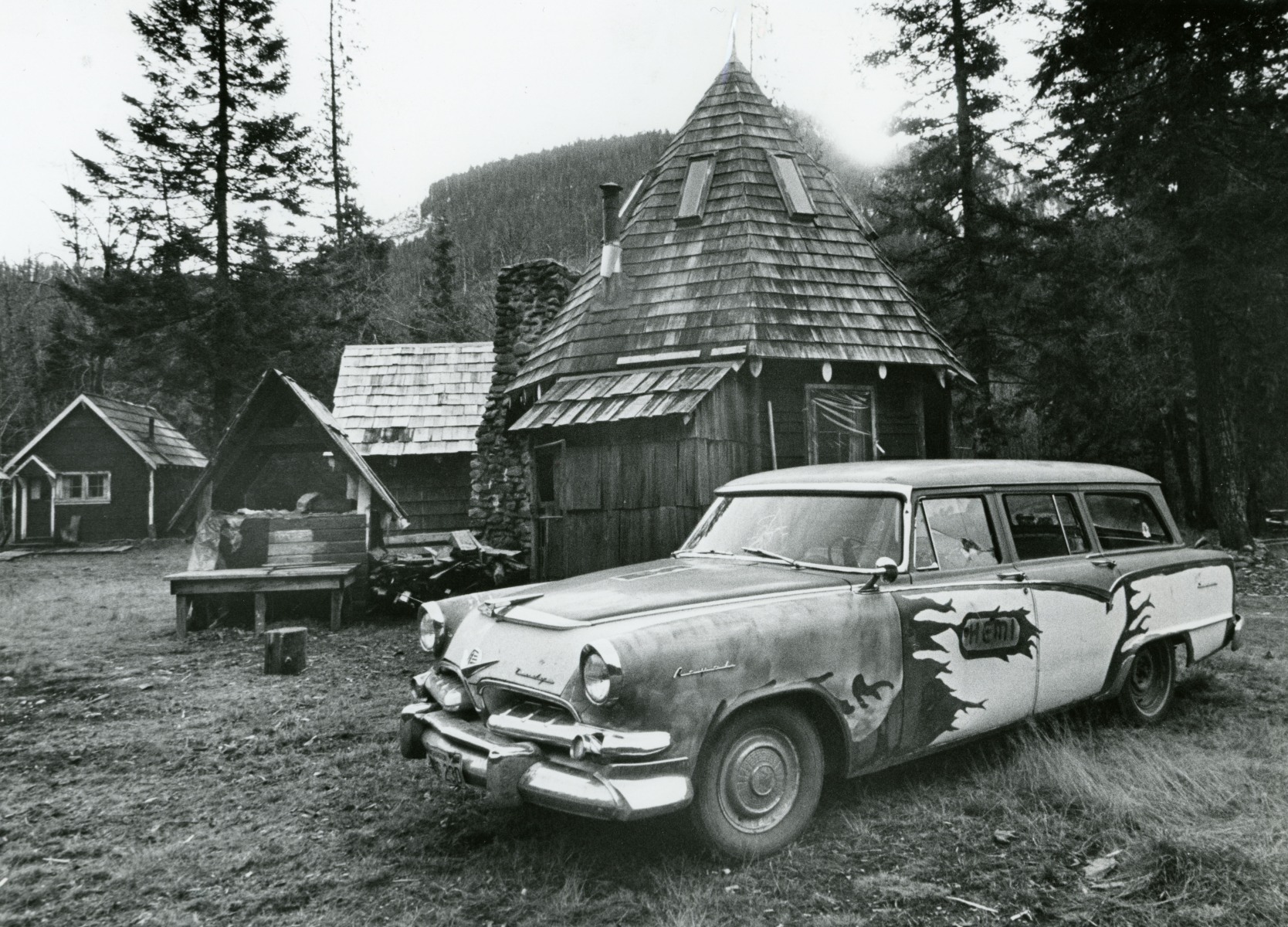
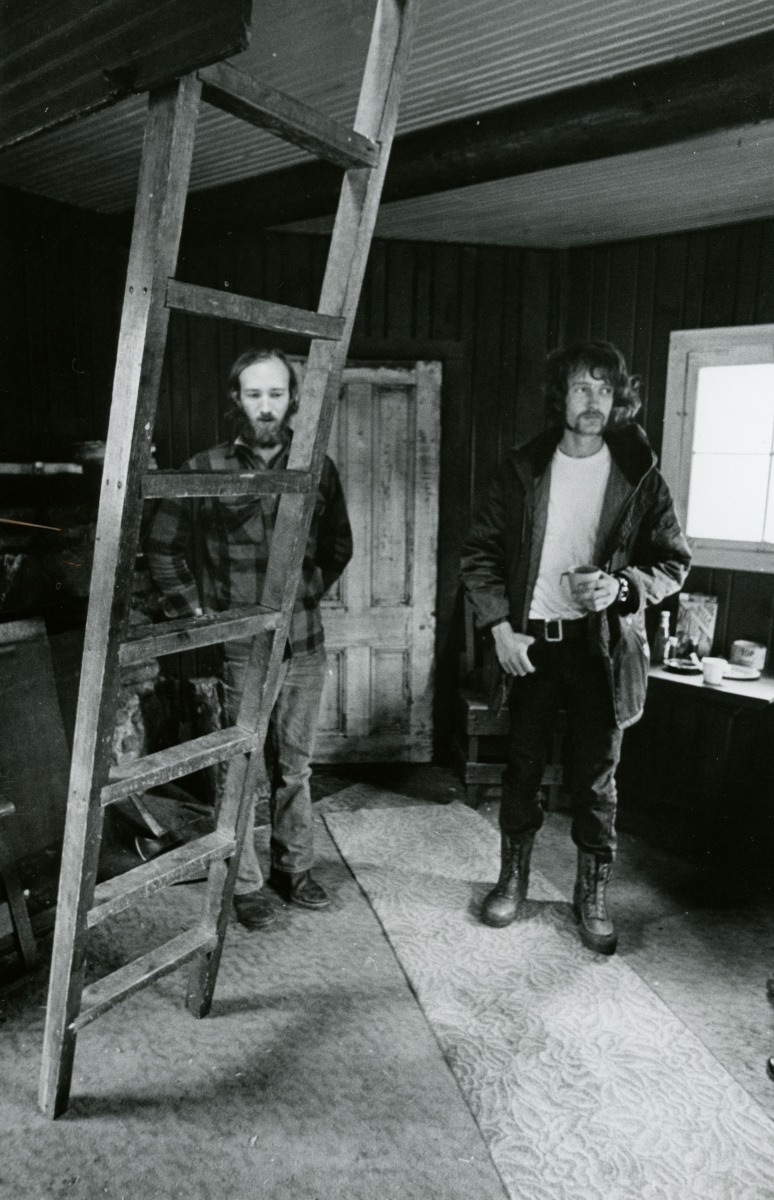
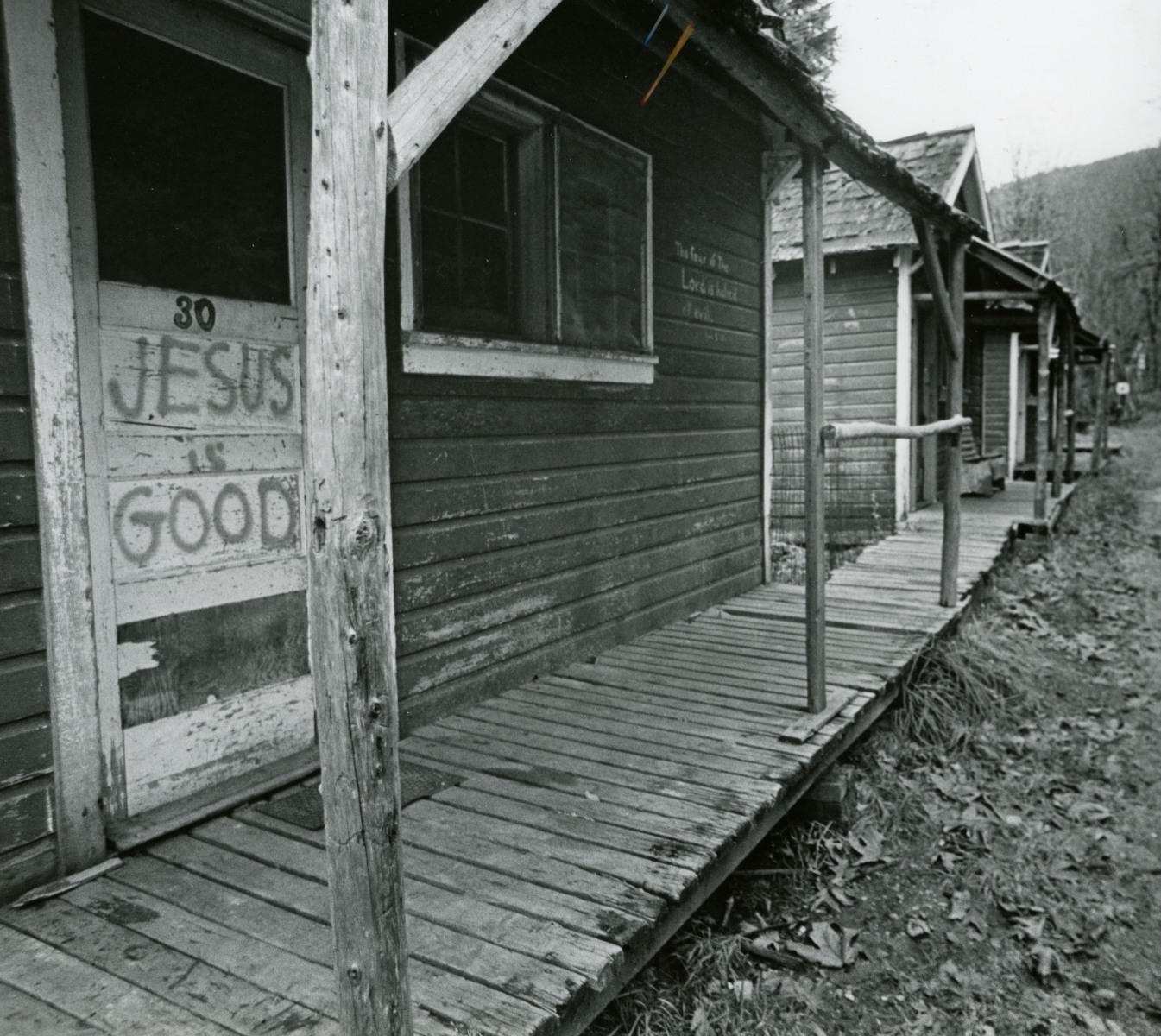
Swimming Pool at Garland Mineral Springs Spring #3 Garland Mineral Springs Cabin #1 at Garland Mineral Springs Inside Cabin #1 at Garland Mineral Springs Jesus is Good
Garland circa 1968 & 1974 photographs by Bruce Kellman and Jerry Buck source: Tacoma News Tribune Tacoma Public Library Northwest Room

The prominent attraction in the former parking lot was my Grandfathers D8 Catepiller tractor. Someone had spray painted "Noah's Arc" on the blade. Presumably a reference to the time Grandpa got stuck in the middle of the river with it. By 72 the tractor was disabled and I never saw it run but I "drove" it many miles those summers. I'm not sure when it lost its motor, but years later Grandpa told me someone came in (he thought by helicopter) and stole the motor out of the Cat.

I will always remember Grandpa filling up bottles with the Mineral Water to take home as he would drink some everyday. He lived to 93, I'd say that stuff works just fine!

During the winter of 1973/74 a family friend, Danny and his wife Jerri had moved into Cabin #1 to act as caretakers. I remember thinking to me they looked like Sonny and Cher. They had two Doberman Pincers and two Tennessee Walker show horses. That winter there was a big snow storm that blocked the Index-Galena Road with a slide. After a couple  of  weeks Dad decided we needed to take them groceries and hay for the horses. Dad had a friend with two snowmobiles so they packed them with supplies and piled on their two young sons to make the day trip up to Garland on snowmobiles.

It was a sunny winter day and was a beautiful trip. When we got the slide we dismounted the snowmobiles and climbed to the top of the pile of debris. As I stood waist deep in the snow with my father knee deep about 6 feet away, we could hear the roar of the first snowmobile as it ascended the hill. Then much to our surprise the snow machine appeared over the crest with the skis in the air... headed straight towards me! My father realized there was nothing he could do as I was just out of reach and he was too deep to get to me in time. The machine landed with a thud and veered off spraying me with snow as it brushed by. My father finally scrambled over and held me in his arms. We finished our trip and delivered the supplies then returned home that evening without incident.

The last fall we lived there I remember my Dad taking me up to Bear falls to see the Salmon jump the falls to spawn up near Garland. The Salmon were so thick in the great clear pool at the bottom of the falls, it looked like you could poke a stick in the water and spear four fish  in one thrust. Watching these majestic creatures swim up the fall was a sight I will never forget.

By the summer of 1974 the economic reality of rebuilding Garland had finally sunk in to my Dad's head. He'd spent two years barely scratching out a living. With my Mom's encouragement, he resumed his sales career with Best Lock and we moved to Pennsylvania. Visits to Garland after that were far and few between. But the memories were  fixed in my mind  forever.

Kylen Sharpe at Garland in 1988
My Daughter Kylen Sharpe at Garland in 1988

About 25 years later I brought my young family to visit Garland. My wife Karen had heard my stories, the fond recollections and the joy of my childhood growing up in Goldbar and going to Garland. By then the reality of Garland had caught up. The cabins had been looted, the  cast-iron stoves were all gone, the gas pumps had been long added to someone else's collection, Noah's arc had sailed away. At the time cabin #1 was still standing but the cabins were in ruin and the river was running through the pool.

20010823-garland-06
Stephen, Stephen Jr. (Scooter) and Cameron Sr. (Grandpa) at Garland in 2001

Now it seems we only visit once every ten years or so. On our last visit the Index-Galena road was wiped out so we took the back way over Jack's pass. Grandpa had passed so we made the trip alone. When we arrived we found Cabin #1 had quietly slipped into the river over the winter.

20090601-garland-02
Karen and Stephen Sharpe at Garland in 2009

Digging around in the bank of the river that day I found a steel bracket that was part of the fireplace in Cabin #1. I have this bracket on my work bench in my garage. It is my "precious souvenir" of the glory days of Garland.

I guess its time to go back!


Grandpa Sharpe telling me were the soda spring is buried. "It's not here."
Grandpa Sharpe telling me were the soda spring is buried. "It's not here." 1988
19881001-garland-08
Curtis, Stephen, Cameron Sr. 1988

19881001-garland-09
Cabin #1 in 1988. Ah the memories!
20010823-garland-03
Kylen, Scooter, Stephen 2001 with big growth trees washing into the river

20010823-garland-05
The "small" cabins closest to the road in 2001
Drinking the Mineral Water at Spring #1
Stephen drinking the Mineral Water at Spring #1 in 2001

20010823-garland-04
Scooter Sharpe crosses the river in the Summer of 2001
20090601-garland-01
By 2009 the river had taken Cabin #1

20090601-garland-03
The small cabins in 2009
20090601-garland-04
The two cabins closest to the river in 2009

20090601-garland-05
The view across the "parking lot" in 2009. Noah's Arc used to sit there.
20090601-garland-06a
The North Fork of the Skykomish river heading down to Index. There are Salmon and Steelhead trying to get to Garland.

20090601-garland-07
Stephen and Scooter on the Index-Galena road in 2009
20090601-garland-08
The washout circa 2009. As of 2015 it's still not fixed.

Filed Under: Stories Tagged With: Garland, goldbar

The Healing Power of the Water

September 15, 2015 by Stephen Sharpe

Memories of Garland from Carrie Starr Weismann circa 1928


This is the “Story of My Infirmity and the Permanent Cure by the use of the Waters of the Starr Hot Springs, near Index, Washington” by Carrie Starr Weismann. Subscribed and sworn to me this 6th day of March, 1928, G. Thompson Notary Public Wilbur, Wash. This was transcribed by Reverend Cameron Sharpe in the 1950's.


Starr Soda Springs

In the year 1870, I was living in the State of New York, and became afflicted with a swelling of my right knee. I was taken to Watertown, New York, to Dr. Spencer, at that time a noted surgeon. Dr. Spencer said it was tubercular, and there was nothing to do but to have the leg amputated.

I did not want to submit to such an operation, so went to consult another doctor, a Dr. Brown. At first he seemed to help me. I had to walk on crutches at that time about 18-months, and could not seem to recover full use of my leg. In the year 1884, I went to Omaha to consult with Dr. Lee, who was one of the surgeons who was called to Buffalo, N.Y. to work on President McKinley when he was shot. Dr. Lee told me that the outcome sooner or later must, in his opinion, be an amputation.

In 1887 I married Dr. J.N. Starr of Chicago, and he took me to Dr. Murphy and Dr. Fonger in Chicago. They both told Dr. Starr that that if he would take me to Puget Sound on the West Coast, where there was no frost, a complete change of air, water and food could be had, that I might improve. We came to Snohomish in the year 1888 in August. But, the change did not seem to improve my condition, and Dr. Starr had about decided to take me back to Chicago.

In a conversation with an Englishman one day, who had come in from the woods near the place now called Index, Washington, the Englishman told the doctor about the wonderful springs in the valley of the North Fork of the Skykomish River. He related that the springs were so charged with gas that a bottle would not hold the water. He also said he had been in Baden Baden, Germany, and he thought the water of these springs were much better than the water at Baden Baden.

Dr. Starr then found a guide, took a pack train and started for these springs. This was in the year 1889, in the month of March. After locating the springs and staying there a few days, building cabins and preparing to take me in, Dr. Starr returned to Snohomish and told me he had found the spring and a cure for my knee. (Note: Age 37). In May 1889, he made preparations to take me to the springs. I went on horseback, as there was nothing from Sultan to the spring but a mountain trail, and a very poor one at that.

The first night, we stopped in Sultan at Mr. Inman’s and the next stop was at or near Index at the Englishman’s. I found his wife a very charming woman. I could not go farther on account of my knee being so painful. In our party with others, we had brought a maid. Dr. Starr left me and the maid at the Englishman’s and he, with the rest of the party went on to the spring with the pack train. In a few days, I was able to travel the rest of the way to the springs, and on reaching the springs and not finding the comforts of life, I was not so well pleased, and I decided that I would not bathe in the water. But, as time went on, and my knee got much worse, I finally decided to bathe in the water. I took two baths every day for three weeks. At the end of the three weeks, I had no swelling in my knee at all, but was still very weak. It was then August, and time for me to go back to Snohomish, so I returned with the pack train.

In the Summer of 1890, Dr. Starr had things much more comfortable at the springs, and I went there and stayed a good share of the Summer. I enjoyed my stay there very much. I bathed in the springs a great deal, and was greatly improved. I soon was fully recovered from my infirmity, and the Doctor proceeded immediately to secure title to the lands on which is located these wonderful springs. We secured the grant, which was signed by Grover Cleveland as President of the United States in May 1896, and have owned it ever since.

Since that time, I have never felt anything of the lame knee, and now at the age of 84 years, I am exceptionally well, weighing a little less than 200 pounds and enjoying extremely my home at Wilber, Washington, with my present husband, Mr. Weismann, Dr. Starr, having died some years ago. While I am still able to do so, I am glad to tell of my complete cure at what is now known as the Starr Hot Springs that others who may hereafter be afflicted in some way may also be able to receive their cure in the same way.

Carrie Starr Weismann
March 6, 1928


Dr. J. N. Starr was an Indiana-born, Chicago-trained physician who came west with his wife Carrie in 1888. After locating the North Fork Skykomish mineral springs in 1889, he and Carrie established the early Starr Soda Springs / Starr Hot Springs site before later settling in Wilbur, Washington, where he practiced medicine until his death in 1909.

Filed Under: History

Garland Mineral Springs Slideshow

September 15, 2015 by Stephen Sharpe

YouTube player

For years friends and family members have been posting photos of Garland on the nwhikers.net website. This is a collection of some of the photos posted on this thread. All images are owned by their respective copyright holders.

What's really special about this slideshow is most of our family's photos of Garland were destroyed in the lodge fire of 1961. My grandfather Cameron Sr. told me once "what we had after the fire, is what we had given away before the fire." Thank you all for sharing them.

Filed Under: Pictures Tagged With: Garland, historic, Index, Mineral Springs, resort

1000-Year Flood of 1959

March 3, 2009 by Curtis Sharpe

Memories of Garland by Curtis R. Sharpe Circa 1959 reposted from NWHikers.net


Curtis Sharpe with cousin Ray Mooney at Garland Mineral Springs

The 1000-Year Flood of 1959: An Eyewitness Account

The 1959 flood at Garland Mineral Springs was one of those events that stayed with everyone who lived through it. The danger arrived when the rising waters of the river began carrying logs and debris directly into the lodge. As the water rose, those inside the lodge were startled by the sound of logs slamming into the side of the building. The lodge had been built with substantial timber construction, and during the flood that strength mattered. Logs and debris struck the building again and again, but the lodge held that night.

Praying as the Flood Roared Around Us

Inside the lodge, the situation was frightening and uncertain. I remember the sound of the flood roaring around the building, the impact of logs striking the walls, and the cries of animals being swept away in the torrent. We did a lot of praying that night.

Before the worst of the flood hit, we had walked the property and everything seemed to be all right. But as we stood near the basement stairs, we looked northeast and saw a wall of water headed our way.

We hurried down the stairs and then back up toward the coffee shop. Along the way, we found that an older man had become trapped in the laundry room in the basement. The floodwaters had risen so fast that the doors could no longer be opened.

We broke the window in the door and pulled him through to safety. After rescuing him, everyone hurried up the basement stairs and into the coffee shop, with the floodwaters close behind us.

As I remember it, the flood lasted all night and most of the next day. It may have lasted longer, but that is how I remember it.

The Basement Filled Almost to the Ceiling

The water continued to rise in the basement, stopping only about six inches from the ceiling. I remember opening, and then breaking, the chain on a window at the top of the stairs so the floodwaters would have a path out of the building. It was one more desperate effort to give the water somewhere to go. The next day, I remember finding our cat on top of the furnace. Somehow, he had managed to keep his head above the water. He survived.

Turning Off the Power

One of the clearest memories from that night was of my father, Cameron Sharpe, walking the pool fence to reach the road and turn off the direct-current power coming from the generator plant on Troublesome Mountain. It was a dangerous thing to do, but shutting off the power was necessary for everyone’s safety. With floodwater moving through the property, the electrical system could have made an already dangerous night even worse.

Cabins Knocked From Their Foundations

The flood damaged the property severely. Cabins 24 and 25 were knocked from their foundations and washed 50 to 100 feet toward the lodge. The Holter family was living in Cabin 1109 at the time. They were not directly affected by the floodwaters, but they lost power when Dad turned it off. They were also stranded and could not reach the lodge until the water receded.

For those in the lodge, the flood was terrifying. For those cut off in the cabins, it must have been a long and helpless wait until the water finally began to go down.

Cleaning Up — Then Being Hit Again

After the floodwaters receded, the cleanup began. Mud filled the basement, and everyone pitched in to remove it one wheelbarrow load at a time.

We placed boards over the basement stairs to create a ramp. A rope was tied to the wheelbarrow, and others would pull from above while James Woolsey guided it. James was wiry and strong, the perfect person for that kind of work. It was all hands on deck.

I remember my father walking out to get help after the flood. He was really a tough guy. It is no wonder he lived to the age he did — 93.

About a week later, the river hit Garland again. It waited just long enough for us all to pitch in and clean the mud out of the basement, and then we had to face the river all over again.

A Defining Garland Memory

The 1959 flood was more than a property-damage event. For those who were there, it was a night of fear, rescue, prayer, hard work, and survival.

The lodge held against the pounding logs. People escaped rising water in the basement. An older man was pulled through a broken window to safety. Cameron Sharpe risked himself to turn off the power. Cabins were knocked from their foundations. Families were cut off. The cleanup took strength, teamwork, and determination.

It is also a reminder that Garland has always lived with the river. The same waters that made the valley beautiful and gave life to the mineral springs could also rise with terrifying force. In 1959, the lodge survived. The people survived. And the story became part of Garland’s history.

Filed Under: History

The Flood, the Fire, the River, and the Springs

July 29, 2008 by Cam Sharpe

Memories of Garland by Cam Sharpe II circa 1959-1961 reposted from NWHikers.net


Cam Sharpe II, Curtis Sharpe, and Jon Sharpe at Garland Mineral Springs

The 1000 Year Flood November 1959

The area around Garland Mineral Springs is a modest alluvial plain with about 12–18 inches of topsoil over river rock from previous periods. The flat area is populated with numerous trees that are several hundred years old, and some stumps with age rings exceeding 1,000 years. The 40-acre historical site at Garland Mineral Springs showed no signs of flooding, probably for several hundred years or more, prior to 1959.

In November of 1959, the “Perfect Storm” of events occurred, beginning the rapid degradation of the North Fork of the Skykomish River.

  • Heavy early snowfall had built up a substantial snowpack of 2–3 feet.
  • A three-day uninterrupted downpour dumped several inches of rain on the North Cascades range.
  • A 60-degree Chinook wind blew through the valleys.

The resultant 100-year high flood took on the character of a 1,000-year high as rapidly melting snow poured into already flooded rivers. Stumps, logs, slash, and debris were swept downstream at high velocity.

The river began to rise far above anything ever evidenced for many hundreds of years, reaching a depth of about 3 feet in the previously untouched Garland Springs, and running swiftly. Wild animals were heard screaming as they were swept downstream. Large trees, vehicles, and cabins were swept by.

The 100-foot by 40-foot, three-story lodge at Garland Mineral Springs shuddered as it was pummeled by enormous fast-moving full-sized trees. After midnight, the pummeling stopped.

The next morning, the dozen or so survivors found that a large log jam had formed where the river should be, diverting it directly into the riverbank and high ground. A second log jam had formed just ahead of the lodge, saving the occupants.

The Lodge Fire January 1961

We had a substantial low pressure boiler to provide steam heat and hot water for the lodge. It was about 7' long and about 5' wide. We burned up to 1 cord of wood daily during the coldest part of the winter. We cut dead trees from our land and were allowed dead firewood from U.S.F.S. land (you probably remember that). When cutting alder or deciduous trees, we would fell them in winter with the sap down so they would be dry. The sap would already have receded in the larger evergreen trees that were no longer living. The daily cutting, splitting and carrying wood in the winter months was quite a project, mostly in a drizzle and sometimes in snow. In the evening, we would bank the wood and it would provide heat through most of the night. Early in the morning, we would use some cardboard to generate a lot of heat and fast start-up for the main fire. This would produce steam heat in about 10-15 minutes. At one time, we learned how to place wet wood on top of a strong fire. The water would generate hydrogen and oxygen, with a hot blue flame. After the fire consumed the hydrogen and oxygen from the water, the dry wood would then burn in a normal manner. This extended the burn-time by some additional measure, possibly an extra hour.

A few days prior to the January 1961 fire, my father Cameron removed the protective screen from the top, and had cleaned the chimney. The screen was scheduled for re-installation that coming Saturday, as he was busy working on a local construction project to supplement our meager income. The weather was clear, and there had been no snow for several days. The cedar shake roof was tinder dry. At mid day, the lodge was getting pretty cool, so my mother Medora put some cardboard in the boiler to generate some quick heat and allow the wood to get going. She was unaware that the screen had not been replaced. Some glowing embers escaped and ignited the roof.

The driver of a passing logging truck stopped to advise that the roof was on fire and assist with evacuation. Firefighting hoses were frozen, and water pressure was generally inadequate to reach the roof at that time of the year. A few records were saved, but not much else. All occupants escaped unharmed. The lodge was fully involved within minutes. As the shell burned away, the extremely robust structure inside was revealed. It had been an extremely stout building, with massive timbers throughout.

I arrived home late from school that night to find no lodge; only an eerie glow as the burning embers illuminated the still-standing chimney. The family moved into round cabin #1. I slept in the loft. We replaced our clothes from Goodwill while the American Legion in Everett donated $200 to help us to get some dishes and cooking utensils. Many friends, relatives and strangers donated clothing, furniture and food.

The River

The North Fork of the Skykomish River in Snohomish County is famous for its summer Steelhead runs and as a major Salmon spawning ground. It is a large tributary to the Snohomish River. During the past 65 years, the river has undergone substantial man-induced change. This has led to heavy downstream silting, possible total loss of the summer Steelhead run, significant degradation of Salmon spawning, and substantial loss of private and public land.

Fisheries and Forest Service regulations became increasingly difficult and prevented us from keeping the river under control. After the 1,000 year high in 1959, the river began braiding back and forth, taking mature old growth trees out on one side, then the other. Each year, 10 to 20 % of the salmon eggs are stranded, which appears to be a significant contributor to declining stocks. 

Recent discussions with Fisheries indicated that there will probably be several years of study, followed by state and federal funding for a multi-million dollar restoration project to keep a consistent salmon spawning ground. It appears that some official don't like rip rap on banks, and gabions are not often allowed as the fish fins can become trapped in them. Fisheries does like what they call "fish friendly" banks made from logs and stumps that provide shelter for the fish.

The section of the N. Fork of the Skykomish River that runs through Garland contains hundreds of thousands of board feet of this log debris piled up in the braids throughout the channel. Dragging them to the banks and tying them in with cables would provide dirt cheap, fish friendly embankments that would do three things. First, it would provide a stable channel for the salmon to hatch. Second, it would stop the braiding. Third, it would protect the valuable mineral springs that are being decimated by the flooding.

During the years, the river has taken on a continuous braiding cycle, eroding one bank, then the other. Debris and many standing old-growth trees are swept downstream each year.

The summer Steelhead run may be extinct, and Salmon eggs fail to hatch as the river continually moves to new courses. The historic Garland Mineral Springs have been severely damaged and may soon be lost to the river.

The Mineral Springs

Are the mineral springs a valuable resource? Recent discoveries by two Arizona State University scientists have found that mineral water and mineral mud from deep springs like Garland have some chemical combination that kills MRSA (methicillin-resistant Staphylococcus aureus). MRSA is a devastating problem invading hospitals around the world. We had known for some time that the Garland Mineral Mud had some spectacular healing qualities, but did not know why. The 25-million gallons of mineral water produced annually, just might be of some benefit to society. If we can save it. 


Filed Under: History

The Day the Air Force Arrived

June 10, 2008 by Stephen Sharpe

In January 1954, Garland briefly became the subject of a military welfare check. A U.S. Air Force helicopter from McChord Air Force Base flew to Garland Mineral Springs after several Boy Scouts were believed to be snowbound there. Lt. James Rogers descended the helicopter by ladder and found that the Scouts had already left before the heavy snowfall.

The minister Cameron Sharpe, his wife Medora, their young daughter Janice, and young son Jon, remained at Garland, safe and in good spirits. The full story was published in the Nevada State Journal 30 Jan. 1954, page 1.

Filed Under: Restore Garland Campaign

I worked at Garland Mineral Springs

June 8, 2008 by Stephen Sharpe

Memories of Garland by Polly circa 1959 reposted from NWHikers.net


I worked a variety of seasons as a housekeeper, waitress, and cook's helper in the mid to late '50's under then owner Cameron A. Sharpe. The gravel road in from Index was 13.7 mi.

There were four mineral springs. They all lay parallel to the main road and just to the left of the entrance. No. 1 and largest was orange-olive green in color and had a strong sulfurous/multi-mineral odor and salty-mineral taste. It was piped under the entrance road into the LARGE swimming pools (small one closest to coffee shop windows was about 3 feet deep and for kids. The big one was graduated. Spring No. 2 was very similar to No. 1 and the one visitors sampled. No. 3 was soda water, and No. 4 was carbonated, had been reclaimed, was wood-lined and we used a dipper for the makings of carbonated beverages or floats for the coffee shop.

On summer time-offs we picked wild huckleberries, made pies, and sold as a favorite in the shop. We accommodated drop-ins and overnight guests for various stays. Only the second floor bedrooms had sinks in the rooms; one had a large claw-footed bathtub for guests demanding a mineral water soak.

The electricity generated by the fast-descending small stream across the main road before reaching the entrance was DC, required converters, and was only available until 10 p.m. Electric appliances were small, like irons for clothes. All linens were transported out for laundering. —Polly

Reposted from NWHikers.net

Filed Under: History

A True Garland Girl

February 24, 2008 by Janis Brotherton

Memories of Garland from Janis (Sharpe) Brotherton circa 1953-1963


Rev Cameron Sharpe, Curtis Sharpe, Cam Sharpe, Jon Sharpe, Janis (Sharpe) Brotherton, Medora Sharpe circa 1958

My name is Janis (Sharpe) Brotherton, the only daughter of Cameron and Medora Sharpe, who with our Aunt Laura Mae Mooney owned and operated Garland Mineral Springs from 1953 on into the 1960's.

I was 8 years old when my family began to make our home at Garland, and lived there until I left to attend college in 1963. I will be retracing my steps through the forest, along the bank of the North Fork, up and down horse trails and logging roads, and yes, even to the foot of Glacier Peak. As I stroll through memories of the 10 years I lived and played at the magical place called Garland Mineral Springs, my hope is that you, Reader, will experience some of the joy and wonder it has stamped into my heart forever.

My parents lived there until about 1966-67. It's been interesting reading the memories and beliefs of the various contributors.

  1. The water in the large spring that supplied the swimming pool was never heated...only pumped into the pool. My father, Cameron Sharpe took regular temp. readings and stated that it maintained a consistant temp. of 68 degrees F even in winter. Real toasty on a COLD day!
  2. The only water heated at Garland Mineral Springs was for drinking, cooking or bathing, and was clear, clean water from our water source on Troublesome Mt. It was piped into the lodge and heated there by a huge wood-buring furnace. The lodge was steam heated, and over 30 cords of wood were used yearly.
  3. I have VERY fond memories of the Petterson family and have often wondered where to find Carol. We were friends, and I spent some overnights in their home. Ernie was an excellent carpenter who constructed the new bath house and a new fire escape staircase at the back of the lodge. I recall sitting in the Coffee Shop listening to him whistle hymns as he worked. He was an amazing whistler, and I can still hear it! My parents really loved Ernie and Alta, and often mentioned their gracious generosity to our family!

I know that my memories and perspectives will never measure up to the writings my mother had been working on before the fire took it all. She never wrote about Garland after that. I believe she closed that chapter in her life.  I guess it will merely remain a sweet memory for those of us who enjoyed that place at that time. There is really not much now to save. The river truly runs through it all!

Filed Under: History

Garland Famous Mineral Springs

February 2, 2008 by Stephen Sharpe

This brochure is courtesy of the Monroe Historical Society donated to the collection by Tim Raetzloff. This brochure mentions W. L. Kaupp the manager of Garland in 1937.


Regain Your Health

Nature’s Healthful Springs

Garland Mineral Springs, an unusual pleasure and health resort, is located on the North Fork of the beautiful Skykomish River, fourteen miles northeast of Index, Washington, and the Great Northern Railway. A good auto road leads direct to the springs.

Being situated at an elevation of 1400 feet on the West slope of the Cascade Mountains, assures cool summer and mild winter weather, an ideal location for a health resort.

It consists of forty acres of virgin timber, native flowers, and mountain streams.

There are several mineral springs, each composed of varying qualities of mineral salts which medical scientists have proven are necessary, in proper proportion, to rebuild and maintain bodily health.

So far as is known to the management, there are no other springs in the country containing so many of these essential mineral salts as are found in these famous waters.

Although discovered in the eighties, it was not incorporated by Mr. A. M. Garland and associates until 1926. These men had the vision and faith to go ahead and develop the property into what is now an exceptionally fine health and pleasure resort.

Bath and Massage Department

New, spacious quarters have been designed for the Hot Mineral Bath and Massage Department. Under this remodeled arrangement, there will be separate departments for the ladies and gentlemen.

A comfortable reception room where one may rest, read or relax, either before or after the treatment, has been equipped with comfortable chairs and restful reading lamps.

Individual locker-dressing rooms have been installed where complete privacy is insured. These rooms are equipped with mirror, chair and a dressing table.

Each department has private, individual bathrooms where one may take a restful bath in the health waters. These baths may be taken in a tub or in a sitz tub. A fresh water shower is also available.

The two massage rooms have been furnished with infra-red lamps and ultra-violet ray lamps along with luxurious upholstered massage tables. A modern colonic irrigation room completes the new outlay of this department.

All baths and treatments under direct supervision of licensed masseur.

Recreation

Hiking

Located in the Heart of the Cascades, with Forest Service Trails leading to many interesting places, hiking is a very popular feature.

Fishing

The North Fork of the Skykomish is noted as the home of the big Steelhead Trout. The river is also kept well stocked with Rainbow, Dolly Varden, and a good run of Cutthroat.

The store at Garland featured bottles of Garland Mineral Water for visitors to take home after their rejuvenating vacation.

The Ideal Resort to

Accommodations

Hotel

The new hotel of twenty-two rooms, is beautifully finished throughout in native knotty cedar. Steam heat, attractive lobby, and comfortable, clean rooms make your stay enjoyable.

Dining Room

The dining room offers good, tasty meals, ranging in scope from short orders to full course dinners, prepared by an experienced chef. Special effort is given to luncheons and dinner parties.

Cabins

Thirty-five cabins, either furnished or unfurnished, modern or semi-modern, are equipped with electric lights and stoves.

Camp Ground

A shady auto park with community kitchen is available to those who travel with their own camping equipment.

Store

A well stocked grocery store is operated for those who wish to do their own cooking. Prices are in line with those of adjacent towns.

Baths

Hot Mineral Baths, Sitz Baths, Men’s and Ladies’ Massage Rooms, Blanket Packs.

Treatments

And benefits of drinking Spring Water---See Masseur.

Swimming Pool

A large outdoor swimming pool, forty by one hundred feet, of heated carbonated mineral water is one of the outstanding features at Garlands, both from a health and recreation standpoint.

Filed Under: History

100 Years of Fascination

February 1, 2008 by Stephen Sharpe

Memories of Garland from Monroe Monitor July 31, 1985 (Courtesy of the Monroe Historical Society).


Monroe Monitor July 31, 1985 • Courtesy of the Monroe Historical Society

Garland Mineral Springs: 100 years of fascination

by Nellie E. Robertson

Garland Hot Springs, 14 miles north of Index in the heart of the Cascade Mountains, has attracted natives and visitors alike for nearly a hundred years and interest in the area hasn’t waned.

The present owner, the Rev. Cameron Sharpe and his late wife Medora, of Sultan, operated the Garland Mineral Springs during the 1950s.

Sharpe, now a widower, would like to see the place as it was before the devastating floods and fire; a place where Christians could gather in a wholesome environment, but his coin purse is empty.

Medicinal qualities found

Dr. J. N. Starr of Chicago was the first to develop the site when his wife, Carrie Starr, was afflicted with a swelling in her right knee which was diagnosed as being tubercular. A series of doctors told her amputation was the only answer.

The last two doctors consulted suggested Dr. Starr bring his wife to Puget Sound where there was no frost; a complete change might help her improve.

The Starrs arrived in Snohomish in August, 1888 but the change did not seem to improve her swollen knee and Dr. Starr had about decided to go back to Chicago when he learned from an Englishman about some wonderful springs in the valley of the North Fork of the Skykomish River near the place now called Index.

The Englishman told them the springs were so charged with gas that a bottle would not hold the water. He also said he had been in Baden Baden, Germany, and the water of these springs was much better.

Garland Mineral Springs, 14 miles north of Index, was a popular spot for vacationers in the middle 1930s who reveled in the European-style spa. Pictured above is the mineral spring-fed swimming pool with the hotel in the upper right. —Pickett photo courtesy of the Index Historical Society

The trek begins

In March of 1889, Dr. Starr found a guide and started for the springs with a pack train. He found the springs and stayed a few days building cabins and preparing to take Carrie into them.

In May of that year, Carrie, age 37, went by horseback along a poor mountain trail to reach the springs. The first night they stopped in Sultan and the next stop was near Index.

Her knee was so painful she stayed there with her maid and the rest of the party went on. In a few days, Carrie followed. In a deposition dated March 6, 1928, when she was 84 years old, she said: “On reaching the springs and not finding the comforts of life, I was not so well pleased, and I decided that I would not bathe in the water.

“But as time went on and my knee got much worse, I finally decided to bathe in the spring water.”

She took two baths every day for three weeks and at the end, she had no swelling in her knee at all.

In August she had to go back to Snohomish for the winter and in the summer of 1890, Dr. Starr had things much more comfortable for Carrie. She “bathed in the springs a great deal and was greatly improved.”

She fully recovered from her infirmity and Dr. Starr “took steps immediately to secure title to the lands on which is located these wonderful springs.”

Title secured

The Starrs secured a 40-acre land grant in May of 1896 signed by President Grover Cleveland and the area was known as the Starr Hot Springs. In 1928 it was known to the U.S. Forest as Soda Springs.

The springs became the Garland Mineral Springs in 1932 when the land was purchased by Charles Garland, Fred Monroe, both of Wenatchee, and Will Jorgenson of Everett.

In two years, there was a 3-story resort hotel with about 40 cabins, a heated swimming pool 105 by 40 feet, and a power plant activated by creek water.

Bert Spada of Index recalled the owners invested a great deal of money in the development and the county road winding five miles up from Galena to the site.

“As soon as the road was done, they had the grand opening and I was invited,” Spada said. “They used to have dances every Saturday night.”

Spada was county road foreman in the area then, a job he held for thirty years, and he did the best he could to keep the road open.

Garland became ill and went back to Wenatchee and the place was eventually sold. It’s said the U.S. Navy had a radio school there during World War II and that it was also a rehabilitation center.

In 1953, the Rev. Cameron Sharpe and his wife Medora, and his sister-in-law Laura Mae (Mooney) Hackama of Gold Bar, bought the property and operated it until the hotel burned Jan. 26, 1961.

Hakama’s first husband was killed in an Army Air Force jet accident in 1953 and she took some of the insurance money to pay half the down payment as a memorial to him. She lived with the Sharpes on the property for eight years.

They bought the Garland Mineral Springs for a place to present the gospel and provide a place that would be uplifting to people. Services were held in the lodge and on the porch.

At that time, in addition to the hotel, there were eight sleeper cabins which also had some facilities, and 14 housekeeping cabins, each with a sink, stove, toilet, electricity, water, and sewer.

The hotel had 22 bedrooms on two floors and every room had a washbowl. There were two lavatories on each floor and two bedrooms had bathtubs. There were showers and tubs in the basement with mineral water piped in to two of the tubs.

The power plant was run on water from Colton Creek. Chairs and tables in the lodge were hand made in Everett.

“It was a pretty nice operation at that time,” Sharpe, who still lives in Sultan, said.

They started the Troublesome Trail Dude Ranch for Children ages 8 to 16 years featuring a variety of activities. The rates in 1958 were $60 a week.

There were two devastating floods in November and December of 1959 covering the property with six feet of water. They were isolated for three days and severe damage was done to the cabins and grounds. Sharpe hiked out in his hip boots with the water and ooze reaching the boot tops.

Sharpe said it was declared a disaster area and the Army Engineers officer stated money could be used to clear and repair the damage but chose not to do the work because they “couldn’t maintain it.”

Sharpe, after contacting seven agencies with no results, built a dike to keep the river in its bed and it held until the flood of 1976.

Rev. Cameron Sharpe drinks from a pool into which the mineral springs feed. Rev. Sharpe drank 4-6oz of Garland Mineral Water daily until he passed at the age of 93 years old on July 15, 2007.

Land surrounded

Sharpe’s property is completely surrounded by U.S. Forest Service land and the forest service has a right-of-way through Garland. The county road ends at the property line and a forest service road abuts the land on the other side.

Whenever low water permitted, Sharpe moved debris and re-opened the normal river channel. He spent about $10,000 on the project.

In 1960, they were closed down because the mineral spring water wasn’t chlorinated. Sharpe was incredulous because the water was so medicinal.

“There wasn’t one incident of infection,” Sharpe said pointing out the many salts and other minerals in the water purified it without adding chlorine.

One spring of clear soda water is 44 degrees the year around; the second spring runs from 70 to 76 degrees any time of the year; and the third one 74 to 80 degrees.

Sharpe said the temptation of the soda springs was too much for a local tavern owner one Fourth of July. He made several trips to the cold spring for the “natural mixer.”

There are 22 minerals in the other two springs. The 150,000 gallon pool was filled in two and a half days from the output of one of the springs.

Dr. Scholatz of the University of Vienna told the Sharpes there were only two springs in the world that compared with Garland for therapeutic quality.

In the middle 1950s, a German woman, wife of a U.S. Army sergeant, was strolling around visiting and took a handful of water from the spring and tasted it. She dropped to her knees and started drinking and remarked that it was just like Baden Baden, Germany where she used to spend two months every year.

Even the animals knew of the medicinal quality of the springs. Sharpe told of a doe who brought her two fawns to the springs. She nuzzled them into the mud and rolled them around. They were allowed to dry and then they went off into the surrounding woods.

Pictured above is what remained of the Garland Mineral Springs hotel after the devastating fire on Jan. 26, 1961. On the left are Amy and Charlie Beavers of Monroe.

Fire destroys hotel

On January 26, 1961, Medora heard a loud rapping at the door of the hotel, and a logger asked if she knew the roof was on fire. He dashed upstairs to see if he could do anything but ran down saying it was too late.

They made three trips inside to gather belongings and that was it; the hotel was a total loss. It left the cabins intact but burned the dressing shed alongside the 105x40 pool and scorched the posts around it.

In December of 1965, they moved to Sultan and then the vandalism began.

Sharpe had gathered about 10 thousand feet of timber to rebuild one story of the hotel and it was washed away in the 1980 flood. He had stacked the fireplace bricks for eventual use and they gradually disappeared.

Rev. Cameron Sharpe surveys what is left of the swimming pool. circa 1985

Deep feelings about springs

“It’s been my life,” Sharpe added. People have wanted to buy it or invest in it but they want control of the policy.

Sharpe said of his philosophy: “I have tried to feel what others are feeling, but I could not extend that to alcohol and it was not allowed because of its destructiveness.”

“I’ve given 32 years of my life to it, and I’d rather let my kids enjoy it than let someone else have it,” he said of the future.

An armed Vietnam veteran usually clad in jungle camouflage clothes is caretaker of the deserted Garland Mineral Springs now and the sign says “No trespassing, survivors will be prosecuted.”

Filed Under: History

  • « Previous Page
  • 1
  • 2
  • 3
  • Next Page »

Recent Posts

  • Four Historic Garland Brochures
  • Historic Organizations That Tell the Garland Mineral Springs Story
  • Precedents for Protecting Mineral Springs
  • Does Restoring Garland Provide a Public Benefit?
  • Beginning the Restore Garland Journey

Archives

  • June 2026
  • May 2026
  • October 2025
  • June 2023
  • September 2017
  • September 2015
  • March 2009
  • July 2008
  • June 2008
  • February 2008
  • January 2008

Categories

  • History
  • News
  • Pictures
  • Restore Garland Campaign
  • Stories

Copyright © 2026 Garland Mineral Springs, LLC